Fairview High School junior Yuna Lee and senior Sieun Jang are already thinking like scientists. Their award-winning research offers a glimpse into the next generation of Colorado’s life sciences workforce.
What do laundry balls have to do with Alzheimer’s disease? For Yuna Lee and Sieun Jang, two Fairview High School students in Boulder, the answer is, more than you might think.
It was the simple idea behind laundry balls, small plastic spheres that keep clothes from tangling, that sparked the concept behind their award-winning science fair research. Yuna wondered whether the same basic principle could be applied at a microscopic level to prevent proteins from clumping together in ways associated with Alzheimer’s disease.
Sieun had never used a laundry ball herself, but Yuna’s idea was intriguing enough that she bought one to see whether it actually worked. It did. That simple experiment helped convince the two students that there might be something worth exploring in the connection between an everyday household object and the complex biology of protein aggregation.
That question led Lee and Jang to a sophisticated project, “Visualization of Beta-Amyloid Aggregation Using Split-GFP in Caenorhabditis elegans for Screening Small Molecules to Mitigate Protein Aggregation in Alzheimer’s Disease.” The work earned them the Future of Life Sciences Award from the Colorado BioScience Institute at the 2026 Colorado Science & Engineering Fair (CSEF), where the caliber of the research stood out to the Institute’s panel of judges.
For the Institute, the award is about more than recognizing an impressive project. It’s about recognizing the students who represent the future of Colorado’s life sciences community. Lee and Jang are already showing what that future can look like.
A Question Rooted at Home
Lee’s interest in beta-amyloid aggregation is both scientific and personal. Her grandfather had Alzheimer’s disease before he passed away, giving her a firsthand view of its impact on a person and a family. That experience shaped the question she wanted to ask. Rather than eliminating beta-amyloid proteins entirely, could researchers find ways to prevent them from aggregating in the first place?
For Jang, the question was personal, too. Her great-grandmother, who lived to be 97, died in part from Alzheimer’s disease. Seeing the disease’s impact firsthand made the problem feel especially meaningful.
Through their research, the students learned that beta-amyloid proteins may serve important biological functions, including roles in synaptic regulation and protection after traumatic injury, which made the aggregation process, not the protein itself, the more interesting target.
That distinction shaped the whole project. Lee and Jang weren’t setting out to discover an Alzheimer’s treatment. They were building a screening platform that could help researchers investigate small molecules that interfere with aggregation, a tool for the next step rather than the last one. It’s part of what makes the project stand out. They weren’t simply following an established experiment; they were thinking about how to create something other researchers could build on.
Learning to Think Like Scientists
Lee’s path to the project began long before she stepped into a lab. Her father, Eui Seung Lee, postdoctoral associate of Molecular, Cellular and Developmental Biology at the University of Colorado Boulder, introduced her to scientific papers early on, not just the findings, but how scientists communicate, weigh evidence, and frame questions. “I’ve been doing that and reading different types of papers for a very long time now,” she said.
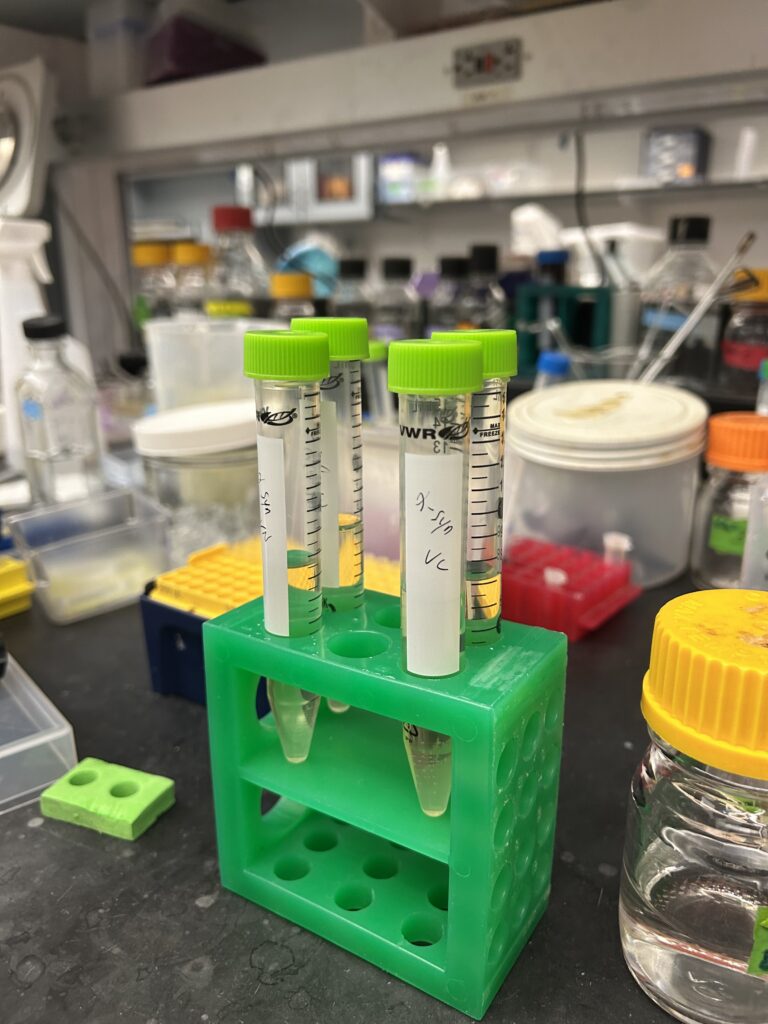
Last year, that background became hands-on when the students got the chance to run a project they had developed themselves. Working with a split-GFP system to visualize beta-amyloid aggregation in C. elegans, a microscopic nematode commonly used as a model organism, they learned to split a fluorescent protein into two pieces that reunite and glow green when the target proteins aggregate. Along the way, they picked up DNA cloning, learned to cultivate and care for live nematodes, and discovered what it actually takes to plan and run a real experiment.
“What we did, there isn’t an answer,” Jang said. “We are searching for the process.”
That was one of the biggest differences between research and the classroom for her. In a classroom, students often learn a process that leads to an established answer. In research, she said, there are many possible paths and outcomes. The experience taught her to think beyond a single expected answer and consider different ways of approaching a problem.
Lee put it more simply: “You have to have a good ability to plan things ahead and plan things really thoroughly.”
When the Plan Doesn’t Work
The experiment succeeded in the ways that mattered most. Lee and Jang obtained green fluorescence and statistically significant results. But the signal wasn’t as bright as they’d hoped, so they tried strengthening it with copper, based on research suggesting it could help. Instead, it produced data they couldn’t use.
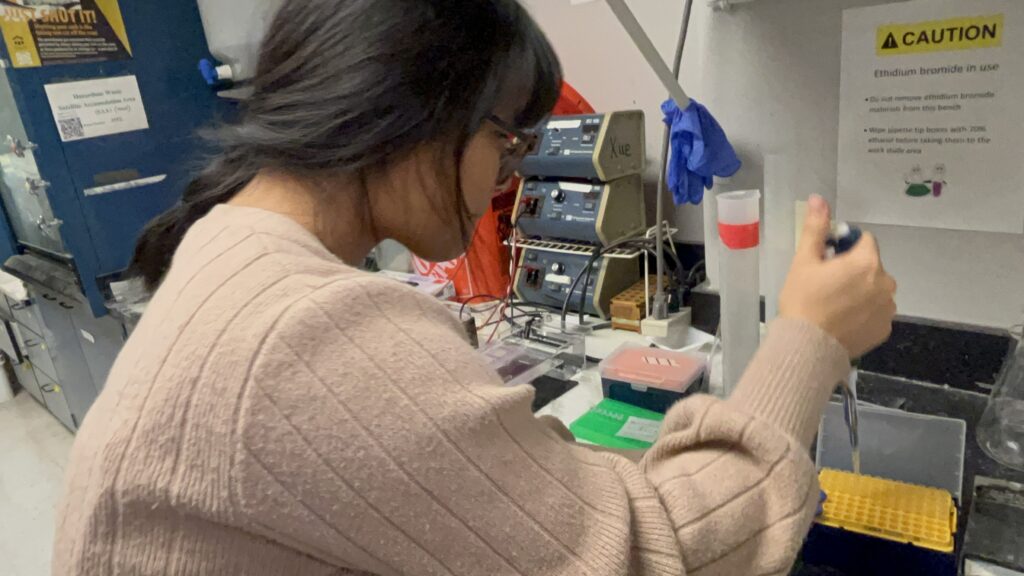
Rather than treating the setback as a dead end, Lee and Jang treated them as part of the
research process. Lee identified another split-GFP system, known as GFP 1-10 and 11, as a possible way to improve the visualization going forward.
“We didn’t give up in the middle,” Jang said. “When things happen that you didn’t expect, it doesn’t necessarily mean you’re wrong.”
That instinct, to keep troubleshooting rather than stop, is something both students are proud of. It’s a lesson a textbook can’t really teach. Reading about a scientific process shows you what it’s supposed to look like, but working with living organisms shows you what happens when it doesn’t.
A True Research Partnership
The students approached the project as a true collaboration. They ran the experiments together and met with their mentor together, making sure they both understood the research process from start to finish. When it came time to create their science fair poster, they divided the work based on their strengths. Jang took the lead on methodology and results, while Lee focused on background research and visual design.
For Jang, that teamwork was one of the most meaningful parts of the experience.
“We did the experiment and everything all together,” she said. “We didn’t give up. [Our] patience and resilience worked together.”
The project also pushed them beyond their immediate surroundings. Their mentor, Eui Seung Lee, Yuna’s father, connected them with scientists in New York and California
as they worked to obtain and understand the C. elegans they needed for their research.
Jang said she is especially grateful for the time he invested in helping them understand the science, and for letting them take ownership of the work.
“I’m really grateful for our mentor,” she said. “He led our pathway and … allowed us to work through all the steps by ourselves as well.”
Looking Ahead
For both students, the award carries meaning beyond the project itself.
“I’m really grateful for that award,” Lee said. “I think it shows how I can think in a creative way that can help society, in the future and the present.”
For Jang, the recognition was meaningful because of everything it took to get there. The
students were still in the lab the night before the science fair, making sure everything was ready. After the uncertainty and exhaustion of getting the project across the finish line, the award gave them a chance to see how far they had come.
Both students see the project as a starting point rather than an ending, and it has changed what they see as possible.
Lee plans to become a surgeon, and the science fair experience has deepened her interest in cellular-level biology, particularly protein aggregation, misfolding and neurodegenerative disease. Born in Boston, she has called Colorado home since she was a year old. As she considers colleges, she’s excited to explore options both in Colorado and beyond, and hopes to keep building on the connections and experiences that have shaped her here.
Jang hopes to become a neurosurgeon and plans to study neuroscience, behavioral science and public health at a college. She said the project confirmed that neuroscience is the right path for her and opened her eyes to how closely it connects with public health.
Their advice to other students considering science is simple. Get your hands dirty. Lee said the best way to learn biology is through hands-on experiences that let students see how a process leads to a specific outcome.
The future of Colorado’s life sciences industry will depend on students who are curious enough to ask unexpected questions, creative enough to approach problems differently and persistent enough to keep going when the first answer doesn’t work.
Yuna Lee and Sieun Jang are already doing all three. The Colorado BioScience Institute is proud to recognize them as the recipients of the 2026 Future of Life Sciences Award and to support the next generation of innovators who will carry Colorado’s life sciences community forward, from classroom to campus to career.