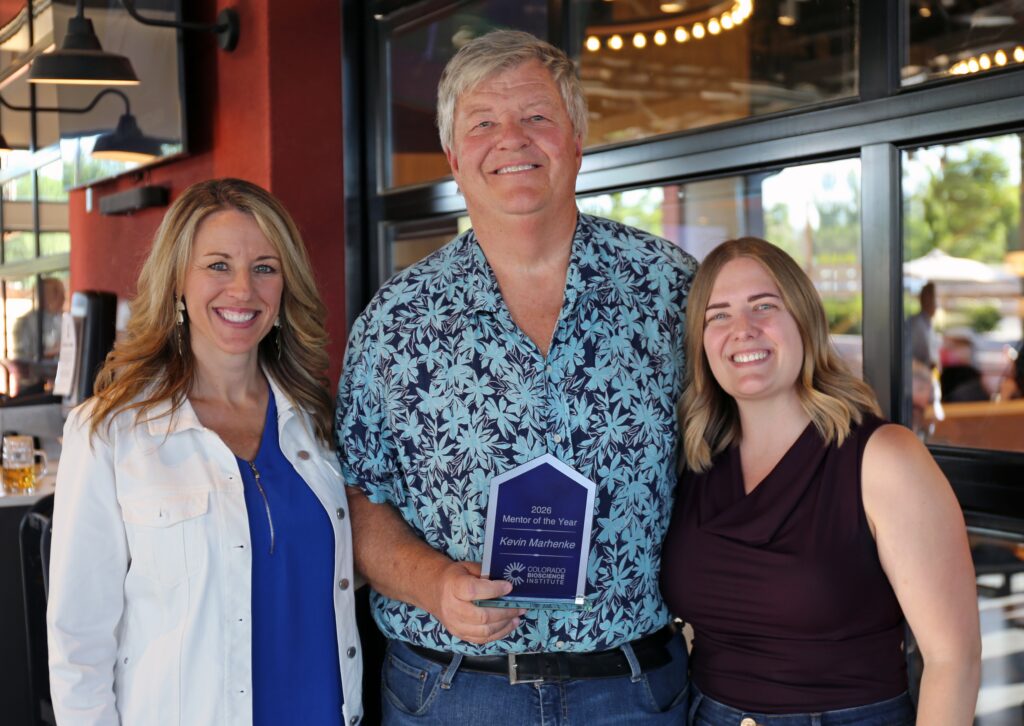
When the Colorado BioScience Institute selected Kevin Marhenke as its Mentor of the Year, the recognition came with one small challenge.
Kevin would prefer the spotlight shine elsewhere.
After a career spanning decades in biotechnology and life sciences, including leadership roles that helped advance patient access, clinical research, and industry partnerships, Kevin remains far more interested in talking about the next generation than his own accomplishments.
Fortunately, those stories tell us a great deal about the mentor he has become.
Through the Colorado BioScience Institute Mentor Program, Kevin has worked with students pursuing careers across the life sciences ecosystem, helping them navigate the often complicated transition between academic training and industry careers. His approach is not centered on giving answers. Instead, it focuses on helping students discover what is possible.
Two of those students, Xuanyu Lyu and Daniel Nwankwo, are pursuing very different research paths. Yet both describe a mentorship experience that expanded their understanding of the industry, strengthened their confidence, and helped clarify their next steps.
Turning Curiosity Into Career Direction
For Xuanyu Lyu, a PhD student at University of Colorado Boulder, the mentorship provided an important bridge between academic research and the pharmaceutical industry.
Originally from China, Xuanyu’s work focuses on developing statistical and computational models that help researchers better understand complex diseases such as Alzheimer’s disease and depression. His research explores how genetics, family environments, and other factors interact to influence health outcomes.
While his technical expertise was already strong, understanding how that expertise could translate into industry roles was less clear.
Through conversations with Kevin, Xuanyu gained a broader view of the life sciences ecosystem and the many career pathways available within it.
“Knowledge and information are power,” Xuanyu explained. “Kevin helped break the information barrier between academia and industry.”
Their discussions ranged from internship opportunities and networking strategies to the structure of pharmaceutical companies and the role data scientists can play in drug development and precision medicine.
One conversation that particularly resonated involved Kevin’s work supporting more inclusive clinical research and helping ensure that underrepresented populations are represented in clinical trials.
For Xuanyu, it challenged assumptions he had previously held about industry careers.
“It inspired me that I can still do good science and help people in industry,” he said.
That perspective helped reinforce his decision to pursue an industry career after graduation. This summer, Xuanyu will complete an internship with Merck & Co., where he will help develop genetic methods to predict how different patients may respond to therapies.
Finding Confidence and Community
For Daniel Nwankwo, a PhD student in biochemistry at University of Colorado Boulder, the mentorship provided something equally valuable: confidence and connection.
Daniel’s research focuses on engineering cell-specific delivery systems that could one day improve treatments for neurological disorders. His goal is to develop technologies capable of delivering gene therapies across the blood-brain barrier and directly to targeted cells.
When he joined the mentorship program, Daniel was still building his understanding of Colorado’s life sciences landscape and where he might fit within it.
Kevin became one of the first people outside of academia whom Daniel could turn to for guidance.
“The mentorship gave me a sense of support,” Daniel said. “If I had a question, I knew I could reach out.”
Their conversations extended well beyond the formal mentorship period. Kevin continued sharing industry resources, networking opportunities, conferences, and career advice tailored to Daniel’s interests.
More importantly, Daniel says the mentorship helped him see new possibilities for himself.
Attending Colorado BioScience Institute networking events and meeting industry leaders helped him realize that impactful careers in life sciences were not only possible, but attainable.
“It made me realize that I could also do something similar,” he said. “I could work on solutions that help patients.”
That encouragement has already translated into action. Daniel has pursued professional development opportunities, attended industry events, and continues exploring ways to connect his research with real-world patient outcomes.
A Mentor’s Legacy
Both students describe Kevin’s mentorship in different ways, but a common theme emerges throughout their stories.
He listens.
He shares what he knows.
And he creates opportunities for students to envision futures they may not have previously considered.
For Xuanyu, that meant gaining insight into the pharmaceutical industry and securing an internship that aligns with his long-term goals.
For Daniel, it meant finding confidence, community, and a clearer path toward translating research into patient impact.
Neither outcome can be measured by a single meeting or conversation. Instead, they reflect the cumulative effect of a mentor who invests time, knowledge, and encouragement into the next generation of life sciences professionals.
That impact is precisely why Kevin Marhenke was selected as Colorado BioScience Institute’s Mentor of the Year.
And it’s why, even as he points attention toward his students, their stories point right back to him.